Its good that there are multiple tools exploring this space.
Does the Conservative Party have a group to balance the ERG?
The ERG seems to have taken over the conservative party. The 40 odd members of this secret society (the membership list is available but not published) have a controlling interest. They have more than half the parties majority.
Where is the balancing group or moderates? Have we no-one ready to challenge them from within their own party?
After the Royal Funeral
The last 10 days have been official mourning for the death of the Queen. In traditional British practice the news coverage has been over the top.
There have been various comments made about how it is inappropriate to question the monarchy during the mourning period.
However it must now be appropriate to question the monarchy before the corronation.
Generative Programming: Wardley Map Analysis
The book “Generative Programming Methods Tools and Applications” was published in 2000. It made the hypothesis that software would follow the same pattern that car manufacturing does.
In the highly automated car production pipeline it is possible to order a highly customised car yet have it built on a stardard production line from standard parts. GP:MTA assumed that this would soon be possible in software.
Dollard 2005 [Code Generation in dotnet] provides some univetsal priniples for code generation that apply irrespective of the implementation language.
We now have the Wonder articles (phase I) but the process stalled there. Dollard 2005 gives the techniques needed. See github.com/chriseyre2000/perfectstorm for an old but distinct implementation of Dollards ideas.
These techniques did not get the required level of adoption so that reusable templates could be produced. This was left at the initial stages of evolution.
In order to be taken further it will require some big adoption that makes it to a confrence paper. This could bootstrap the reusable catalog idea.
Code generation like this is not a 4GL, merely a means of extracting the business details from the implementation technology. You can achieve reuse without using up key options (single inheretence languages can avoid using up this powerful tool).
Minimise noise in logs
Try to keep the logs quiet. If something is happening we need to know. Logs can tell you that things are happening or have gone wrong. A request for intervention should be made once, pteferably by opening an alert on OpsGenie
Try to keep error messages clean. If possible treat warnings as errors. Noisy compile messages will hide real errors.
The Royal Queue
This was an inspired and truely British thing to do to form a queue to pay tribute to the late Queen. Currently it is a 10 mile queue that can take upto 24 hours to complete.
Queues as entertainment are not new as Legoland has been selling this for years (one visit had 7 rides each preceded by a one hour queue). This is however the first time we have had a televised queue with its own TV feed and incinsistently run twitter feed. At one point the queue was closed on twitter, but failed on two counts: they did not tell the people at the start of the queue, and when they did is it resulted in the formation of a second unofficial queue.
Self organising queue management is something inherent in the British character. Americans are amazed that post office queues work without anyone policing them. This is a single queue with several servers handling it. These form in many stores and self manage.
CI Issue
In most CI setups a build process is triggered on push to a PR (or a given pattern for the name of the branch).
To avoid having to fetch everything anew it it common to cache succesful runs of the main branch and use that at the start of each CI run.
This works fine as long as the PR is ahead of main. However in active teams (or in a monorepo with many teams) it is easy to get behind. This can cause odd effects. Typically this presents as errors that exist on CI that don’t exist locally and vanish when the branch is updated.
One solution would to cache per branch but initialise the cache to the main.
Another posibility is to datestamp the main cache and only use the most recent one older than the current branch.
Both of these require careful cache management.
kino_wardley version 0.7.0
The new version was published to hex.pm last night. It includes markets.
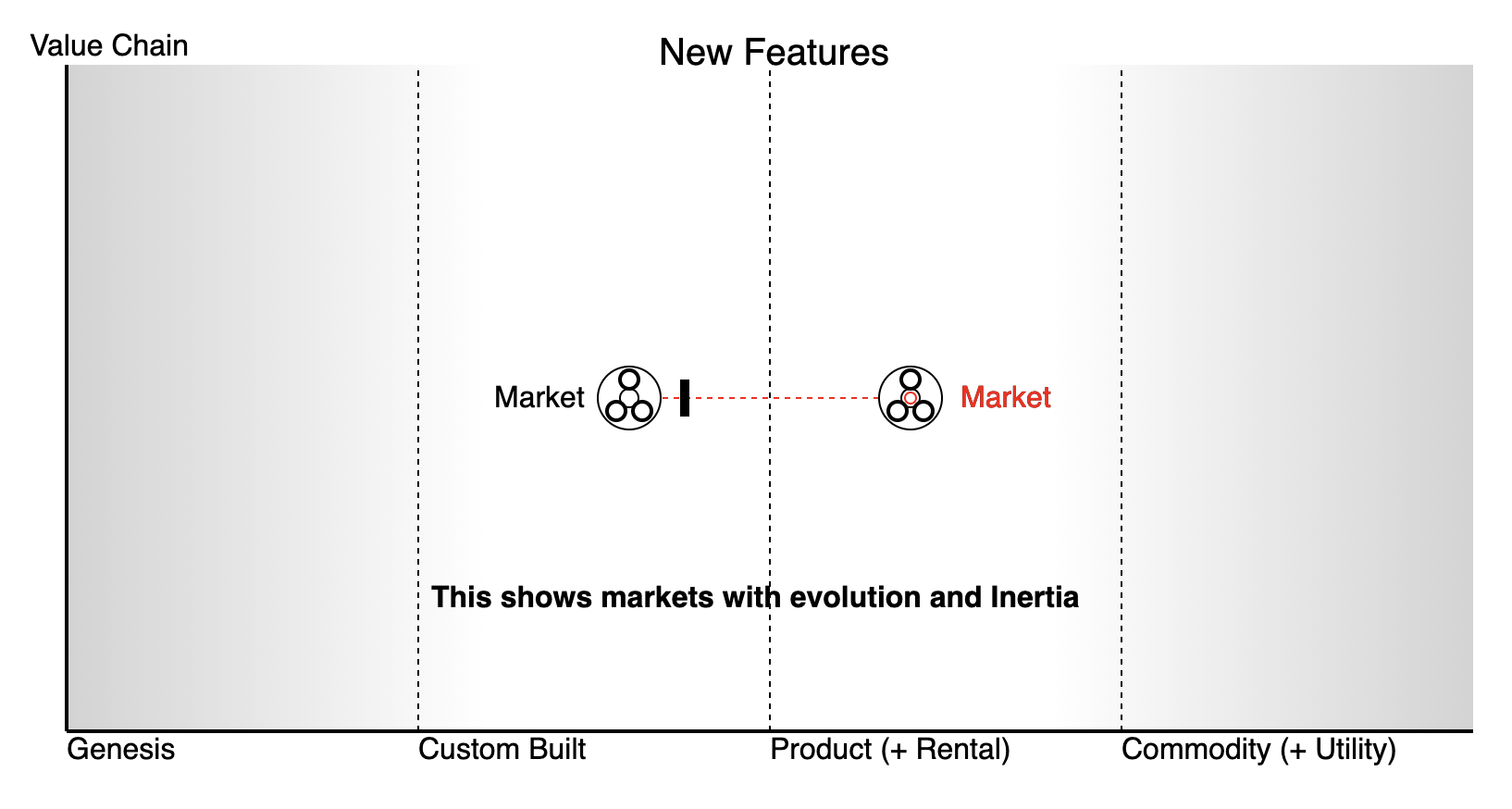
This was generated using the following:
KinoWardley.Output.new("""
title New Features
style wardley
market Market [0.5, 0.4] label [-80, 0] inertia
evolve Market 0.6 label [20, 0]
note This shows markets with evolution and Inertia [0.2, 0.25]
""")
Only a few features required to achieve parity with onlinewardleymaps.com
Missing items include:
– pipelines
– build/buy/outsource markers
Wardley Mapping in HR
This is an interesting use of a wardley map in a domain that differs from most examples:
Telling Stories with Wardley Maps
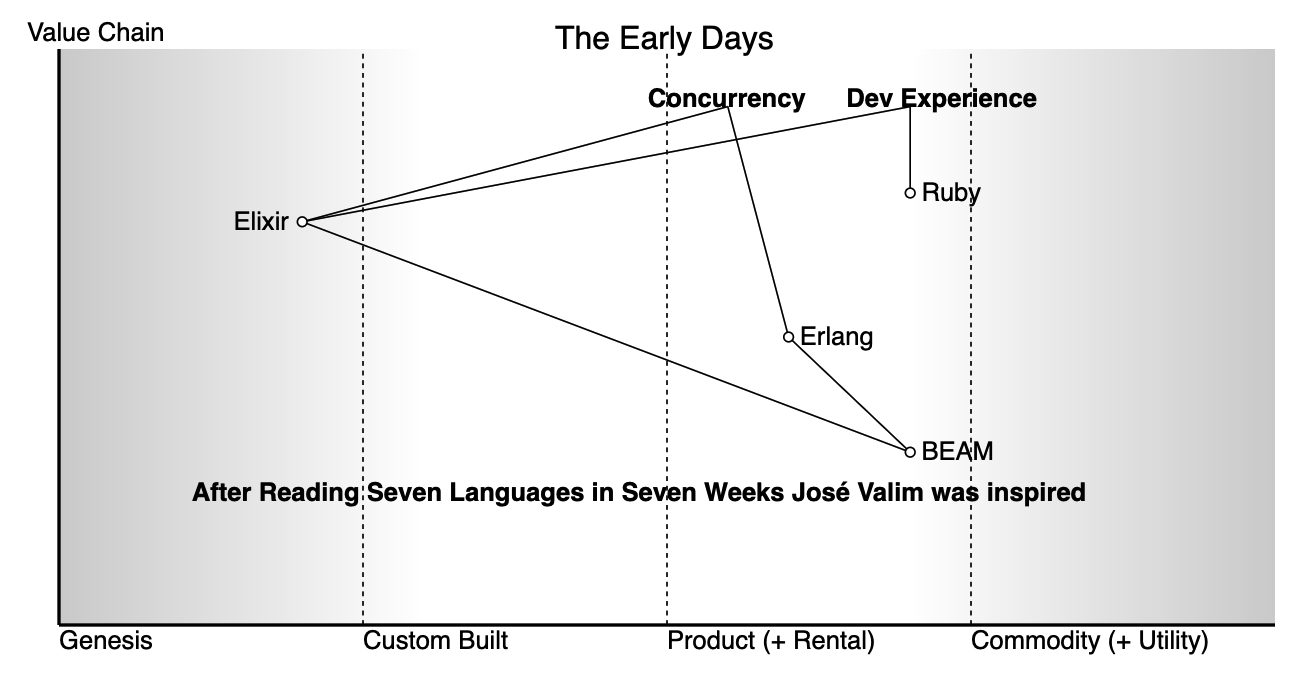
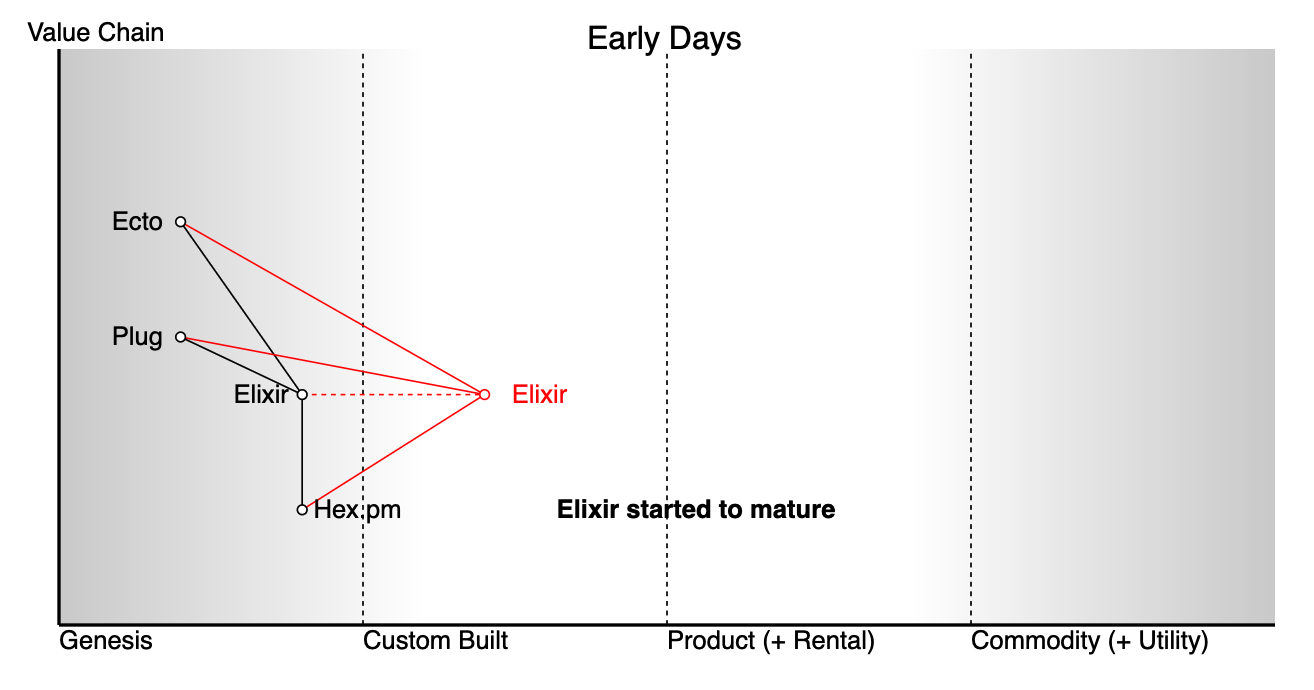
Here is a livebook that I plan to expand into a history of Elixir:
https://github.com/chriseyre2000/livebooks/blob/main/history-of-elixir.livemd
I am aware that Wardley Maps are meant to be the alternative to stories, but they can be used to tell them.
Here is the first Map
Next Steps:
 Developer Rants